What Is Cavitation Erosion?How collapsing bubbles wear metal away, and how to reduce it in hydraulics
Cavitation is the formation of bubbles in a liquid when its pressure falls. Erosion is the wearing away of metal surfaces by the shock of those bubbles collapsing.
Together they are called cavitation erosion.
Key points
- Where the flow speeds up the pressure falls and bubbles form. When the pressure recovers downstream the bubbles collapse, and the shock erodes the material.
- In hydraulics the bubbles come from air that was dissolved in the oil.
- A published test reports that removing the bubbles from the oil cut the eroded mass to one quarter.
1. From bubble formation to collapse
When a liquid passes through a narrow passage it speeds up and the local pressure falls. Below a certain pressure, bubbles appear in the liquid. They are carried downstream and collapse where the pressure has recovered. At the moment of collapse a high pressure is produced around the bubble, and when this happens again and again near a wall, the surface is gradually worn away.
← 図は横にスクロールできます / Scroll the figure sideways →
2. In hydraulics, the bubbles are dissolved air coming out
In water pumps and ship propellers the bubbles are water vapour. Hydraulics is different, because the pressure in a hydraulic circuit rarely falls far enough for the oil itself to vaporise.
Hydraulic oil holds 8 to 10 % of its volume in dissolved air at atmospheric pressure. When the pressure falls, that air comes out as bubbles. Almost all the cavitation seen in hydraulic systems comes from this air [1].
There are two places where cavitation tends to occur. One is at restrictions such as valves: the larger the pressure difference across the restriction, the more readily it occurs. The other is near the pump inlet, when the pump speed is too high or the suction filter is clogged.
3. What cavitation does
| Erosion | Metal parts are worn away and fail. |
|---|---|
| Vibration and noise | Vibration and noise appear, and can lead to pump failure. |
| Higher oil temperature | The oil runs hotter and degrades sooner. |
| Lower pump delivery | The pump delivers less oil. |
4. Two ways to deal with it
One is to stop the pressure from falling so far: change the bore or shape of the restriction, or lower the resistance on the suction side of the pump.
The other is to reduce what the bubbles are made from. Since cavitation in oil is dissolved air coming out, less air in the oil means less cavitation [1]. The test in the next section examines this second approach.
5. The test: removing the bubbles cut the erosion to one quarter
This test was carried out as joint research between the late Ryushi Suzuki, who developed the bubble eliminator and whose business our company carries on, and the laboratory of Professor Yutaka Tanaka at Hosei University. It used a rig that produces cavitation on purpose to examine the effect of the bubble eliminator. The result was written up by Dr Sayako Sakama (now Assistant Professor at Hosei University) in a review article [1]. The video at the top of this page shows a jet under the same conditions.
← 図は横にスクロールできます / Scroll the figure sideways →
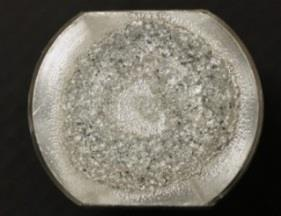
No bubble eliminator
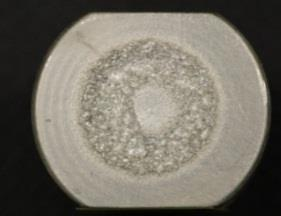
With bubble eliminator
Test conditions
| Pressure upstream of the restriction | 40 MPa |
|---|---|
| Pressure downstream | 0.14 MPa |
| Restriction | Cylindrical, 0.7 mm bore (stainless steel) |
| Specimen | Aluminium alloy (JIS A1070) |
| Oil | Mineral hydraulic oil (32 mm²/s at 40 °C), at 50 °C |
| Without the bubble eliminator | Air injected at the pump inlet, 0.58 L/min |
| With the bubble eliminator | Oil from which the bubbles in the reservoir had been removed |
| Measurement | Jet applied for 10 minutes; mass loss of the specimen measured every 2 minutes |
Results
- High-speed video (20,000 frames per second) showed a smaller white region - the cavitation bubbles - when the bubble eliminator was used.
- After 10 minutes under the jet, the eroded mass of the specimen was one quarter of that without the bubble eliminator.
"...the amount of erosion is reduced to one quarter." (our translation)
Read the original article (open access)
It contains the drawing of the rig, the photographs of the jet, the erosion graph and the photographs of the eroded specimens. The four-page article also covers the effect on oil degradation and on the stiffness (bulk modulus) of the oil.
Open the article on J-STAGEWhat the result does and does not show
What it shows is that, under these test conditions, removing the bubbles from the oil reduced both the cavitation and the eroded mass.
The author also notes that the result is likely to change considerably with oil temperature [1]. How much erosion is reduced in real equipment depends on the pressure, the oil and the temperature.
Related pages
- Operating principle of the Bubble Eliminator
- Foam and bubbles: what is the difference?
- Filling a tank without entraining bubbles - and the physics behind it
References
- S. Sakama: Bubble eliminator for hydraulic oil (in Japanese), Journal of the Society of Instrument and Control Engineers, Vol. 54, No. 9, pp. 664–667 (2015) https://doi.org/10.11499/sicejl.54.664
Affiliations and titles as of November 2026. Yutaka Tanaka: Professor, Department of System Design, Faculty of Engineering and Design, Hosei University. Sayako Sakama: Assistant Professor in the same department.
Feel free to ask for consultation or quotation