Foam vs. Bubbles: What’s the Difference?
In engineering, the terms “foam” and “bubbles” may seem interchangeable, but they refer to different phenomena and must be clearly distinguished.
Definitions
- Definitions: A collection of gas pockets enclosed by thin films of liquid that accumulate on the surface of a liquid. This is often referred to as surface foam.
- Definitions: Gas particles dispersed throughout a liquid. These are known as dispersed bubbles.
The key distinction lies in the location and behavior of the gas within the liquid:
- Foam = Surface phenomenon
- Bubbles = Dispersed within the liquid
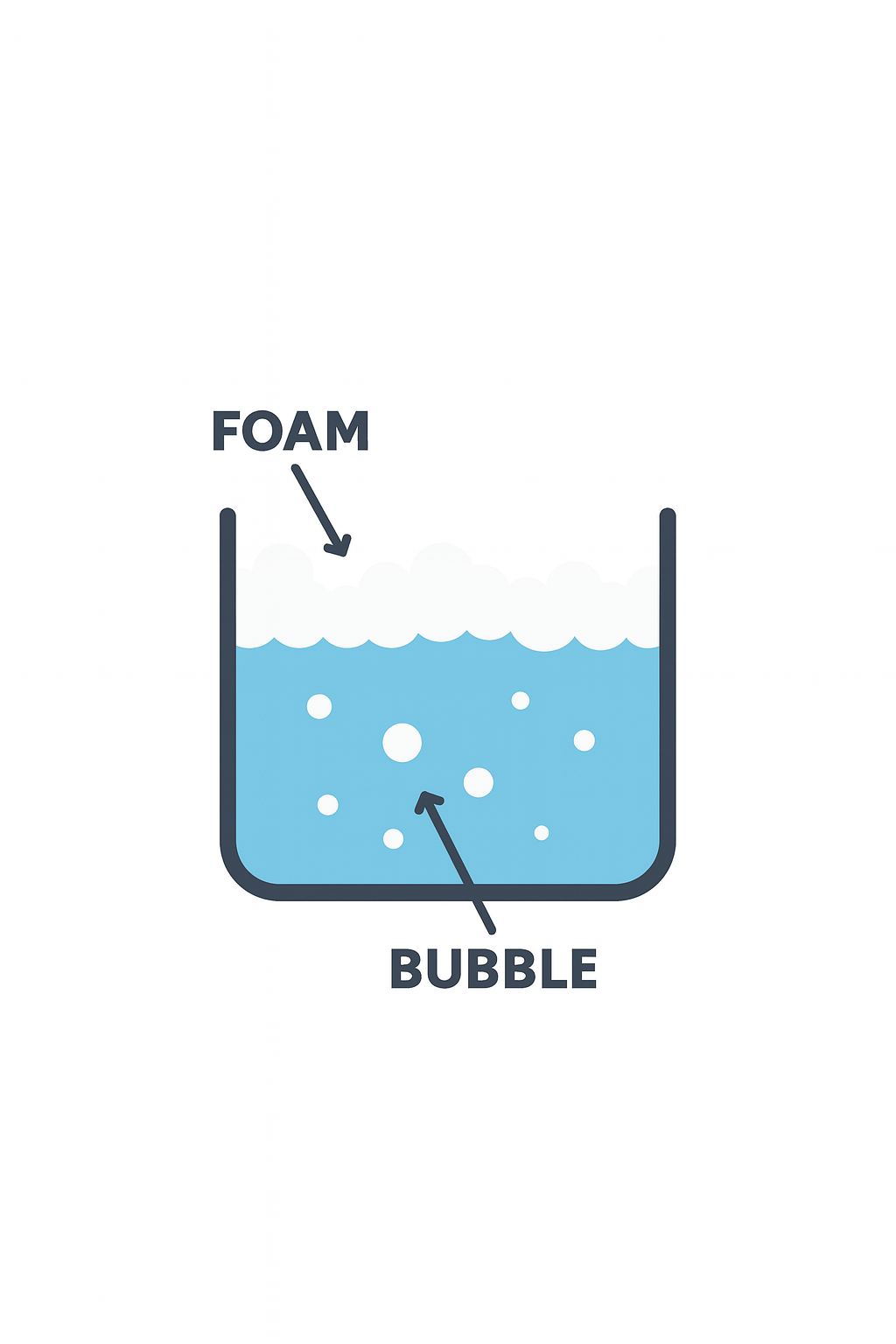
Surface Bubbles (Foam)
Surface bubbles form when gas is trapped in thin liquid films and float on the surface of a liquid. These are often the visible foam you see at the top of a tank or container.
Causes:
- Typically generated by the accumulation of dispersed air bubbles.
Problems:
- Can lead to overflow from tanks or containers.
Solutions:
- Defoaming agents such as higher alcohols or silicone oils can be added.
- The process of removing surface bubbles is called defoaming.
Dispersed Bubbles
Dispersed bubbles are tiny gas pockets suspended within the body of the liquid itself. These are often invisible but can cause significant issues in fluid systems.
Causes:
- Mechanical agitation or liquid falling
- Cavitation or vibrations
- Air entrainment due to sloshing
- Trapped air within the system during startup or filling
Problems:
- Can disrupt fluid flow, affect measurement accuracy, and lead to system malfunctions.
Solutions:
- Defoaming agents are typically ineffective or may worsen the situation by hindering bubble rise.
- A bubble removal device is required to extract these dispersed bubbles from the system.